

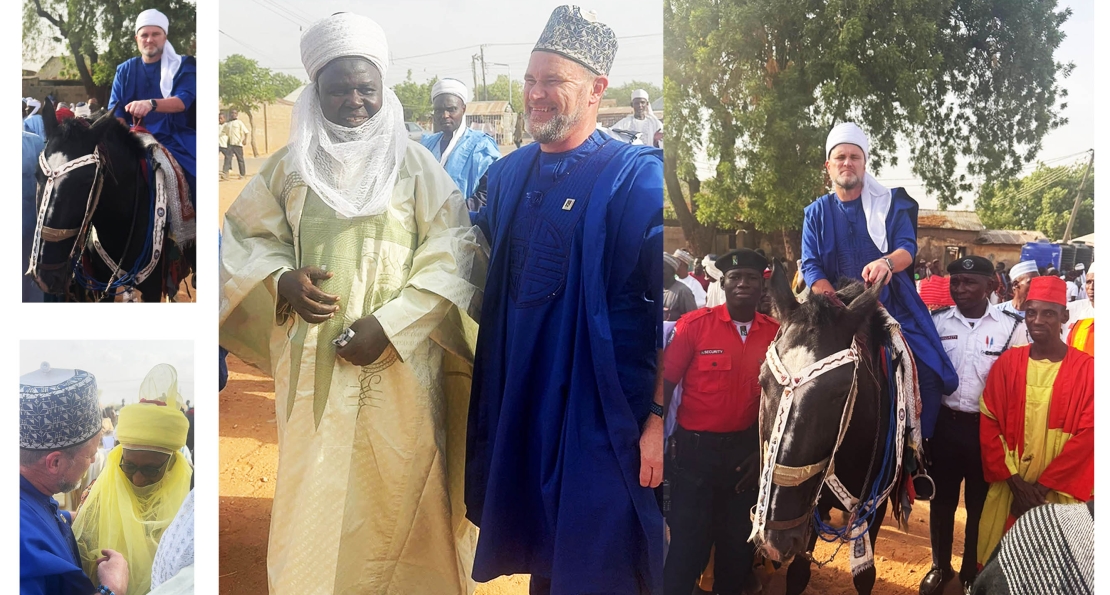
In a moment that blended modern leadership with centuries-old heritage, the President of the American University of Nigeria (AUN), Prof. DeWayne Frazier, rode into the historic city of Yola on horseback, standing shoulder to shoulder with the custodians of Adamawa’s living traditions.
On March 18, 2026, Prof. Frazier joined the Bole Community to accompany the District Head of Bole–Yolde Pate as they fulfilled one of the Fombina Emirate’s most symbolic rites, the formal entry of all district heads into Yola on the eve of Eid-el-Fitr.
For centuries, the Emirate has upheld this procession, a regal display in which district heads ride elegantly into the capital city, reaffirming loyalty to the throne and celebrating unity among the diverse peoples of Adamawa. The custom reflects the deep political, cultural, and spiritual significance of the Lamido’s authority, drawing participants from far and near to honor the revered seat of the Fombina Kingdom. To the people of Yola, this procession is a collective reminder of identity, continuity, and the enduring presence of traditional institutions.
Prof. Frazier’s active participation was not mere ceremonial courtesy but heartfelt involvement. Known across AUN and Yola for his genuine immersion in local culture, the AUN President arrived mounted on horseback alongside royal members of the Bole–Yolde Pate district, proudly representing his community as they paraded toward the palace of His Royal Highness, the Lamido Adamawa, Dr. Muhammadu Barkindo Aliyu Mustafa.
The horses made their stately march through the Eastern Gate, where crowds gathered to witness the colorful procession. Upon arrival at the palace entrance, Prof. Frazier dismounted and personally greeted the Lamido, an action that resonated deeply with spectators and elders alike. In a community where respect for hierarchy is expressed through deeds more than words, his gesture spoke volumes.
This was not Prof. Frazier’s first encounter with Adamawa’s cultural heritage, but it was one of his most symbolic. His presence reflected a leader who does not simply reside in Yola but who belongs to Yola. Many remarked that his involvement carried a message: that the traditions of Fombina are not relics of the past but a living heritage capable of inspiring people across cultures and continents.
On Sallah day, the President returned, this time at the Western Gate of the palace, where he witnessed the mini-durbar, a vibrant display of horsemanship and royal splendour. The durbar, a cherished emblem of Northern Nigeria’s identity, once again illustrated the harmony between the old and the new, between leadership and community, and between tradition and modernity.
Prof. Frazier’s participation reaffirmed a powerful truth, that culture thrives when it is embraced by both its heirs and its guests. As the sun set over Yola that day, many residents spoke of a university president who not only leads an institution of learning but also honors the heartbeat of the land that hosts it.
Reported by John Abah