

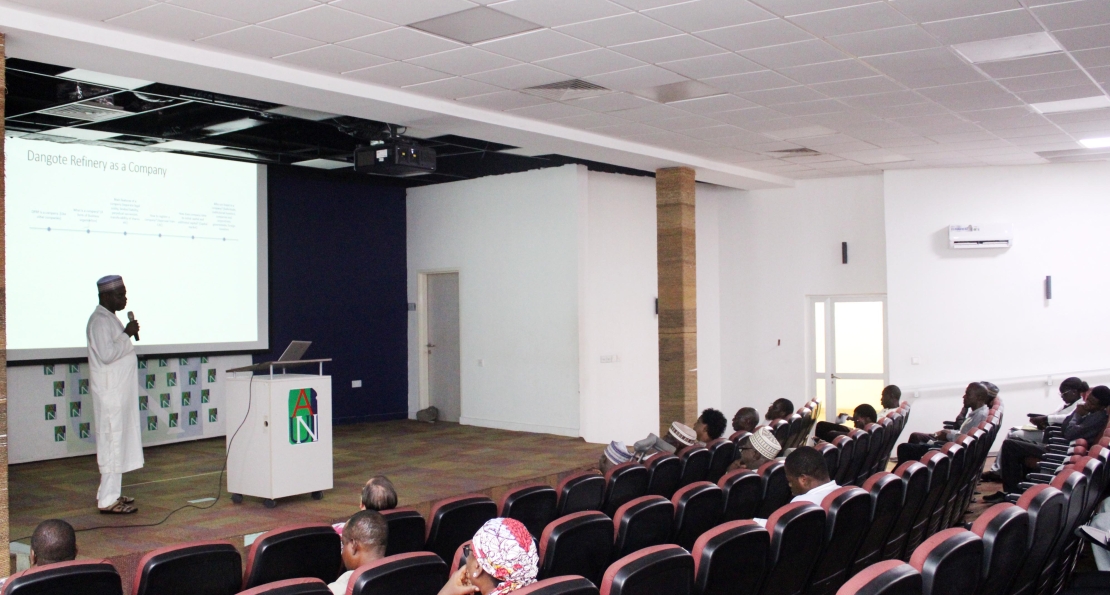
Scholars from the School of Business and Entrepreneurship (SBE) at the American University of Nigeria (AUN) are bringing academic insight to one of Nigeria's major industrial and investment developments, examining the investment opportunities and economic implications of the proposed Dangote Refinery IPO.
The discussion took place on October 8, 2026, at the e-Library Auditorium as part of the SBE Brown Bag Seminar Series. Titled Facts, Fictions and Understanding Its Investment and Economic Implications, the session explored the significance of the proposed offering for investors and the wider Nigerian economy.
Prof. Bashir Ahmad Daneji, Director of the MAU Business School and Adjunct Professor at AUN’s SBE, highlighted the role of academic engagement in helping prospective investors understand equity investment and the broader purpose of corporate listings.
He explained that companies go public for several reasons, including raising capital for expansion, managing debt, improving share liquidity, and broadening ownership. The proposed Dangote Refinery offer provided a practical context for examining how capital markets can connect major industrial enterprises with a wider pool of investors.
According to figures presented at the forum, the proposed offering comprises 4.1 billion shares at ₦525 per share, representing approximately ₦2.1525 trillion, with a minimum subscription of 10 shares. The scale of the offer and the refinery’s strategic importance to Nigeria’s energy and industrial sectors have attracted considerable public attention.
Discussing the factors behind this interest, Prof. Daneji pointed to the refinery’s reported valuation of $18.5 billion, its position as Africa’s largest single-train crude oil refinery, and its capacity to produce key fuels, including petrol, diesel, and aviation fuel. He also noted the influence of Aliko Dangote’s business reputation in drawing attention to the offering.
Beyond the transaction itself, the seminar connected the refinery’s development to broader questions of domestic energy supply, industrial capacity, capital formation, and Nigeria’s economic prospects. These considerations also highlighted the potential for major industrial investments to stimulate economic activity and create opportunities across related sectors.
He encouraged prospective investors to consult official offer documents, including the prospectus and relevant disclosures published by the Securities and Exchange Commission (SEC) and Nigerian Exchange Group (NGX). He emphasized the importance of understanding the terms of an offer, evaluating the available information, and aligning investment decisions with individual financial goals and long-term plans.
The seminar also featured different academic perspectives on the relationship between industrial growth and investment decisions. While some participating professors highlighted the refinery’s commercial potential and its implications for Nigeria’s energy independence, others emphsized the importance of global transitions toward cleaner energy and technological developments that could shape the sector’s long-term outlook.
Reported by John Abah