

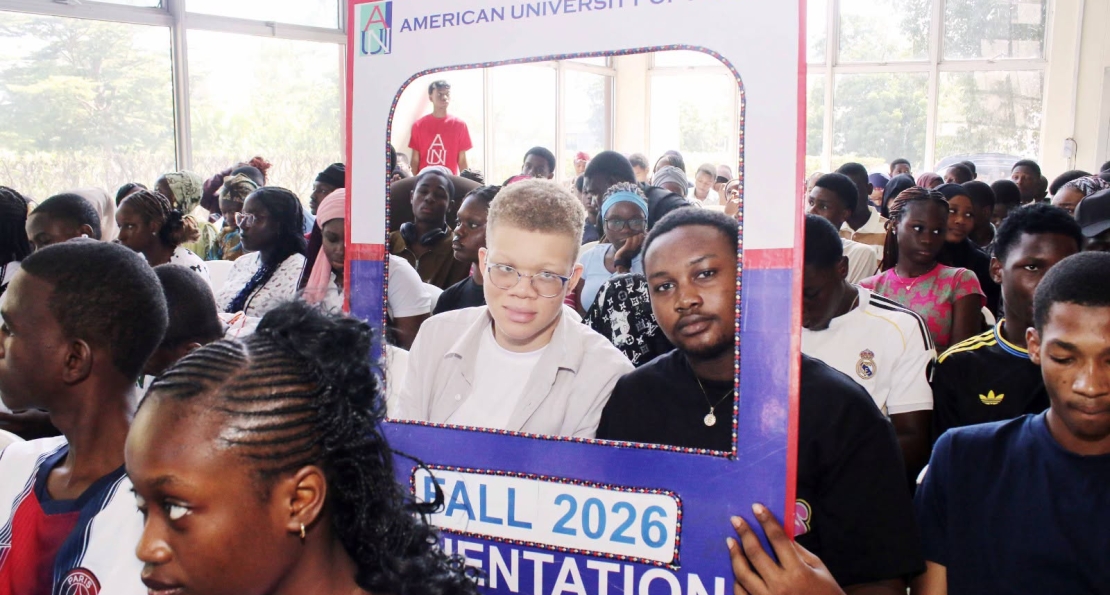
The American University of Nigeria (AUN) has recorded a 15 percent increase in enrollment for the 2026–2027 academic year, as growing student demand coincides with continued investment in academic programs, student housing, campus infrastructure, sustainability and community development.
Addressing the University community on September 28, 2026, AUN President Prof. DeWayne Frazier thanked students, faculty, staff, alumni and other stakeholders for their contributions while outlining a series of initiatives designed to strengthen the University and support its continued growth.
Among the immediate priorities is improving facilities across campus to meet the needs of the growing student population.
“The university has undertaken extensive campus improvements, including repairs to residence-hall air conditioners, walls and exteriors, dormitory repainting, new furniture, basement renovations, and exterior upgrades to the Schools of Law and Engineering,” Prof. Frazier said.
AUN is also looking beyond the immediate needs of its current students. The University is in the final stages of discussions to construct two state-of-the-art residence halls with a combined capacity of 600 to 800 students, significantly expanding residential capacity for future cohorts.
The campus is also becoming more energy efficient. AUN is expanding its renewable-energy initiatives through lithium battery systems, solar-powered inverter air conditioners, six new inverter units in the Library Auditorium, solar power at the main gate, and solar lighting along the driveway leading to the “I Love AUN” sign.
“The university is also expanding its renewable-energy initiatives through lithium batteries, solar-powered inverter air conditioners, six new inverter units in the Library Auditorium, solar power at the main gate, and solar lighting along the driveway to the ‘I Love AUN’ sign,” he said.
At the academic level, AUN is preparing for National Universities Commission accreditation visits covering distance learning, engineering, nursing and other programs. The University is also exploring new degree programs in medicine and psychology, further broadening its academic offerings.
The expansion extends beyond conventional degree programs. AUN has received approval from the Federal Ministry of Education to offer Technical and Vocational Education and Training (TVET), with approximately 250 participants expected to gain practical skills in areas such as solar installation and fashion design. The program reflects the University’s emphasis on connecting education with practical skills and emerging economic opportunities.
That same commitment to impact extends into the wider community. The Atiku Institute for Development (AID), AUN, is preparing to launch its iDICE program to equip young people with computer skills, while continuing its collaboration with the United Nations Development Programme (UNDP) on the Nexus for NGOs and other development initiatives. Together, these efforts reflect AUN’s founding vision of “A Private University with a Public Mission.”
Taken together, the University’s investments in its campus, academic programs, renewable energy, technical skills and community initiatives underscore AUN’s continuing evolution as a development university—one that connects academic learning with innovation, entrepreneurship, practical engagement and service to society.
Prof. Frazier commended the Admissions Enrollment Team, President’s Ambassador Team, Marketing Team and President’s Media Team for their contributions to enrollment growth and AUN’s growing visibility across Nigeria and beyond. He also thanked the Board of Trustees and Governing Council for their continued commitment and voluntary contributions to the advancement of the University.
Concluding his address, Prof. Frazier assured students and the wider AUN community that the University’s “best days are still ahead,” reaffirming his ambition to build an institution worthy of its place among the leading universities in the region. He envisioned an AUN whose academic growth, innovation and development impact would continue to distinguish it as the “Harvard on the Benue.”
Reported by John Abah