

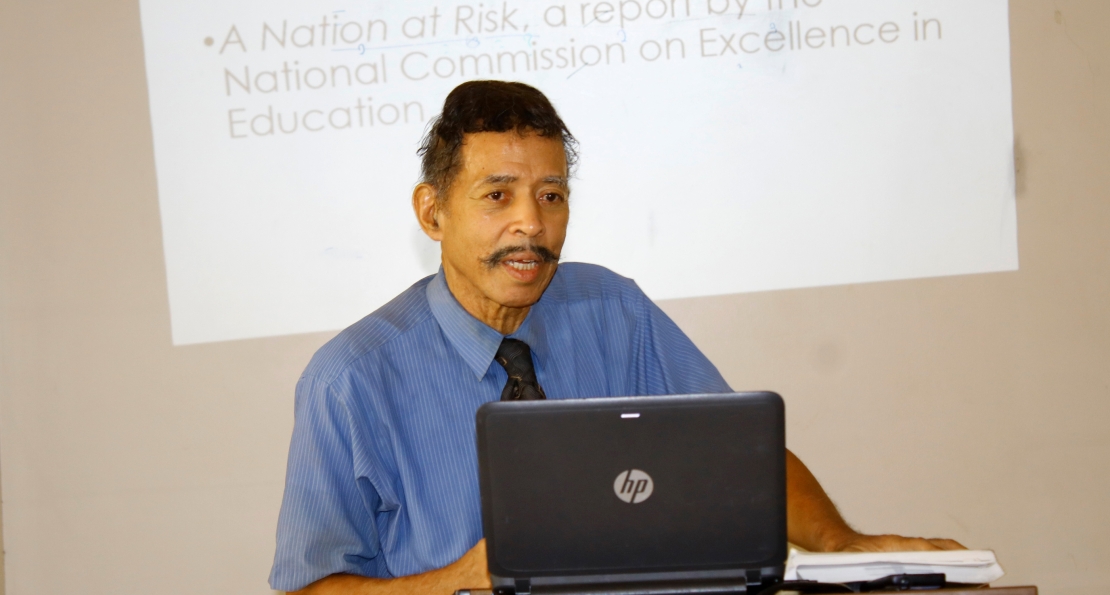
Effective classroom assessment helps lecturers understand how students are learning, identify gaps in their understanding and adjust their teaching approaches. These issues came into focus during a President's Book Club Review at the American University of Nigeria (AUN).
Organized by the university's Teaching and Learning Centre (TLC) on November 13, 2026, at the 24-Hour Capacity Library, the session focused on Classroom Assessment Techniques: A Handbook for College Teachers by Thomas A. Angelo and K. Patricia Cross. Dr. Brian Reed led the discussion.
In her welcome remarks, the Dean of the School of Arts and Sciences, Dr. Agatha Ukata, highlighted the role of classroom assessment in strengthening teaching and improving students' learning experiences. She also encouraged faculty members to take advantage of opportunities to reflect on their teaching practices and consider ways to make them more effective.
Dr. Reed then guided participants through the book's central ideas, explaining the characteristics of effective classroom assessment. These include being learner-centred, teacher-directed and mutually beneficial to both lecturers and students. He also discussed key principles of assessment, stressing the importance of making it formative, course-specific, continuous and an integral part of good teaching.
Moving from principles to practice, participants examined several assessment techniques outlined in the book, including the One-Minute Paper, Word Journal, Approximate Analogies, Invented Dialogues, Classroom Research and Annotated Portfolios. Examples drawn from philosophy, literature, fine arts, education and mathematics showed how these methods can help lecturers gauge students' understanding, encourage critical thinking and promote greater classroom participation.
The review also allowed participants to ask questions, share experiences and discuss how the techniques could be applied across different academic disciplines. Their contributions reinforced the value of continuous assessment in helping lecturers understand students' learning needs and make appropriate adjustments to their teaching.
In his closing remarks, Provost Prof. Agboola thanked participants for their contributions and acknowledged the collective effort that made the session a productive academic exchange.
The review reflects AUN's commitment to faculty development and the continuous improvement of teaching and learning. Through the President's Book Club, TLC creates opportunities for faculty members to engage with educational ideas, share experiences and explore practical ways to enrich the classroom experience.
Reported by Udoh Victoria Clement
Faculty Engagement