

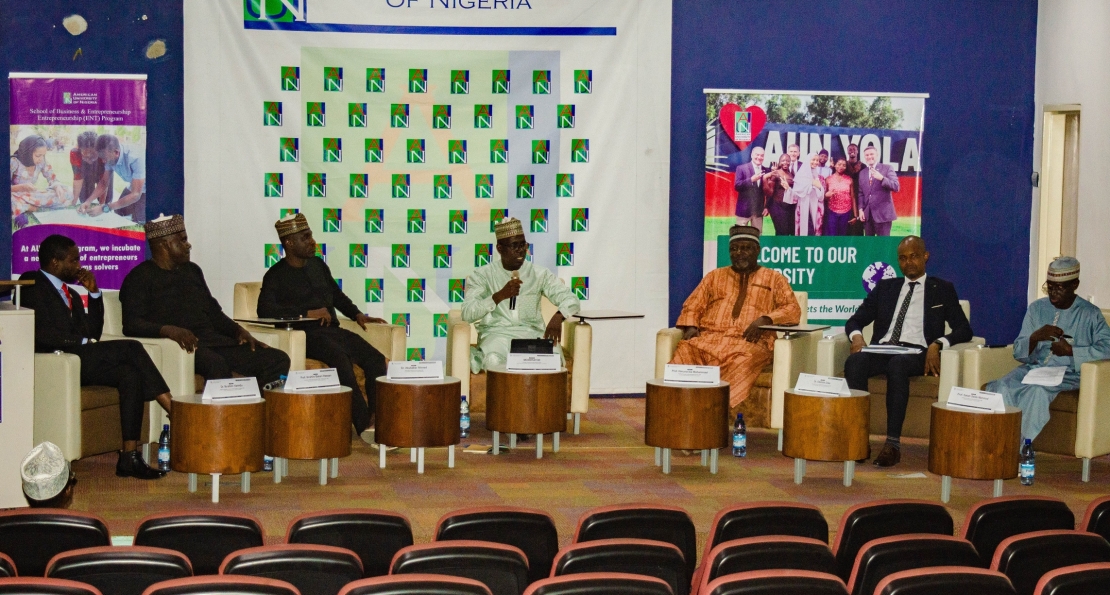
A panel of experts at the American University of Nigeria (AUN) has faulted the Federal Government's handling of the 2023 fuel subsidy removal, raising concerns about transparency, accountability and the lack of adequate measures to cushion its economic impact on Nigerians.
The concerns emerged during an interdisciplinary discussion organized under the School of Business and Entrepreneurship (SBE) Brown Bag Seminar on November 20, 2026, at the University e-Library Auditorium, ahead of AUN's 18th Founder's Day Ceremony. The seminar brought together academics from Political Science, Law, Management, Economics, Accounting and Finance to examine the implementation of the subsidy reform, government accountability and its implications for Nigeria's economy.
The discussion featured Prof. Ibrahim Bakari Hassan, Dr. Ibrahim Hamidu, Dr. Obinna Dike, Prof. Haruna Isa, Dr. Abubakar Ahmed and Prof. Saka Saidu Mahmoud.
The panelists questioned the government's preparedness for the economic consequences of removing the Premium Motor Spirit (PMS) subsidy, arguing that the policy was implemented without adequate planning or effective social protection measures. They also expressed concern that shortcomings in transparency, accountability and public communication had weakened public confidence in the reform.
They pointed to the pressure rising petrol prices had placed on households and businesses, particularly through higher transportation and production costs, which have contributed to increased prices of goods and services. They stressed that major economic reforms must be accompanied by safeguards that protect vulnerable citizens and help ease the burden on their livelihoods.
The discussion also placed Nigeria's policy choice in a wider context, with the experts examining how other members of the Organization of the Petroleum Exporting Countries (OPEC) continue to use various forms of fuel subsidies to shield consumers from high energy costs. One the panelist describing the approach as an insensitive policy that amounted to a declaration of economic war on the populace.
Beyond their concerns about the reform's implementation, the experts proposed alternative approaches to addressing the country's economic and production challenges. They called for targeted, indirect subsidies to support manufacturers and producers, rather than broad interventions that may fail to address the structural constraints facing the productive sector. Such support, they argued, could lower production costs, ease pressure on supply chains and ultimately make goods and services more affordable for consumers.
The conversation also turned to Nigeria's energy transition and the need for sustainable responses to its persistent energy challenges. The panelists urged the country to make better use of international climate finance opportunities, identifying natural gas as an important transitional energy resource and calling for greater investment in solar power and mini-grid infrastructure.
They noted that expanding access to alternative and renewable energy sources could reduce dependence on petrol, improve electricity access and strengthen industrial productivity, particularly in underserved communities. These investments, they argued, would help lay the foundation for a more sustainable and inclusive approach to Nigeria's economic development.
Reported by John Abah