

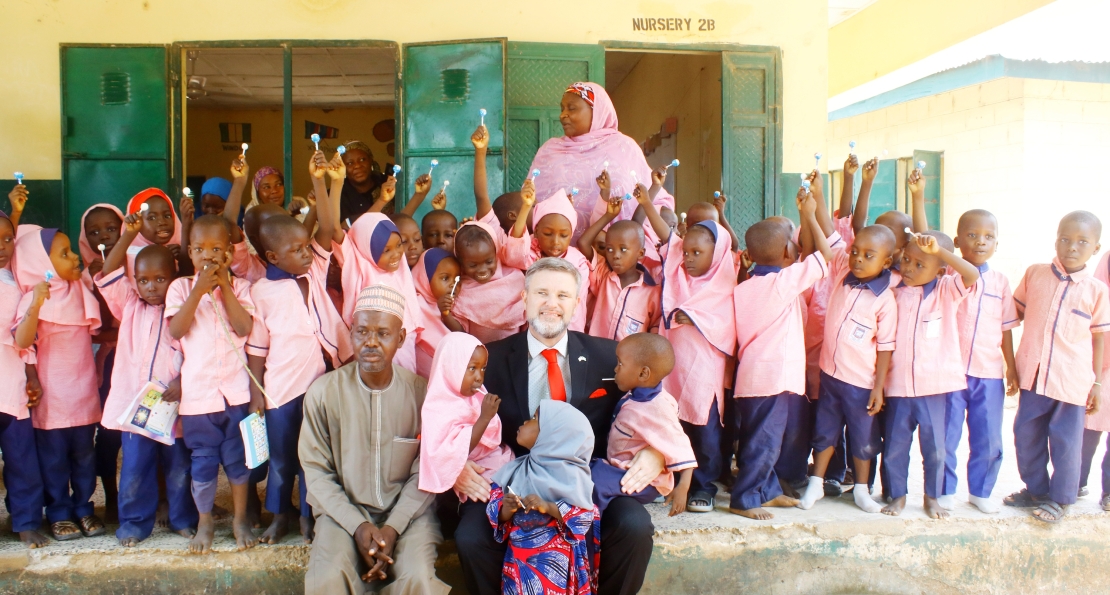
In communities around Yola and Girei, the impact of a university can be measured in more than degrees and research. It can be seen in a child returning to school, a woman acquiring a skill to support her family, a repaired school desk providing pupils with a better place to learn, or a university student discovering that knowledge becomes more meaningful when it is applied to a real-world problem.
These are among the ways the American University of Nigeria (AUN) is giving practical expression to its identity as a “development university,” linking what happens on campus to the social and economic needs of surrounding communities.
That connection is deliberate. According to Ahmed Aliyu, Director of Community Services, civic engagement is embedded in the university’s institutional identity. “The mission is clear, it is for the community to benefit from the university itself,” Aliyu said.
The philosophy takes shape through voluntary projects, mandatory service hours and curriculum-integrated activities that connect students with challenges beyond the classroom. From their first days at the university, students encounter opportunities to engage with communities, applying their knowledge while contributing to the places in which they live and learn.
Education provides one of the clearest examples of this connection. Across Yola and Girei, AUN community projects have supported public schools through structural repairs, desk refurbishments, tree planting and the provision of learning materials. Students have also contributed their time and knowledge by tutoring pupils in subjects such as English and Mathematics.
Yet the significance of educational intervention is measured not only by improved facilities, but also by whether children who have been excluded from education regain access to it.
Last semester, 2025, AUN helped return 168 out-of-school children to formal education, exceeding its initial target of 70. Dozens more have been re-enrolled during the current term. Behind those figures are children whose connection to the education system has been restored, opening pathways to opportunities that extend well beyond the immediate intervention.
The same emphasis on opportunity extends to AUN’s economic empowerment initiatives. Approximately 21,000 women have received training in practical, income-generating skills, including tailoring, shoemaking, cosmetology and the production of household products such as soaps and disinfectants. As participants progress, they are introduced to producing items such as school and laptop bags, creating opportunities to move from acquiring individual skills toward developing small enterprises.
The longer-term value of such programs becomes clearer when skills translate into leadership and collective economic activity.
One graduate of the tailoring program, for instance, progressed to become president of a women’s cooperative representing 300 local entrepreneurs. Her journey illustrates how skills development can extend beyond initial training, creating pathways to enterprise development, collective organization and community leadership.
That movement from intervention to empowerment also shapes the role of AUN students in community development.
More than 50 registered campus clubs provide platforms through which students identify community needs, mobilize resources and organize projects. The Honor Society, for instance, has organized clothing drives to provide essential items to vulnerable families, while residential halls have used service competitions to encourage greater participation in community work.
These experiences add another dimension to AUN’s approach. Students are not simply learning about social challenges; they are encountering them directly. They listen to communities, assess needs, mobilize resources, work collaboratively and develop practical responses.
In the process, community engagement becomes an extension of the classroom. Leadership, problem-solving, empathy and civic responsibility are developed through direct experience, while communities benefit from the skills, energy and resources students bring to their projects.
Students who complete 50 hours of voluntary community work receive formal institutional certification, reinforcing service as an integral part of the university experience. The emphasis, however, extends beyond completing a requirement. It is about developing graduates who understand how knowledge can be applied to challenges beyond their immediate professional and personal interests.
That local work forms part of a wider development architecture within AUN. While the Community Services Department concentrates much of its work in communities surrounding Yola, specialized university bodies such as the Atiku Institute for Development pursue broader development grants and initiatives across the North-East.
The connection between these levels is significant. Community projects address immediate needs close to the university, student engagement turns service into experiential learning, skills programs create pathways to economic empowerment, while broader development initiatives extend the university’s reach across the region.
Taken together, these efforts demonstrate how higher education can connect academic learning with the development challenges of the society around it. A child returns to school; a woman acquires a livelihood skill; a beneficiary progresses into community leadership; and a student learns to turn knowledge into action.
The impact, therefore, extends beyond the university’s physical boundaries. It is reflected in the opportunities created in surrounding communities and in the experiences that shape students as they prepare to contribute to society.
That is the promise embedded in AUN’s identity as a development university. Connecting education with real-world challenges and ensuring that the knowledge, skills and resources generated within the university contribute to progress beyond the campus.
By Jummai Paul