

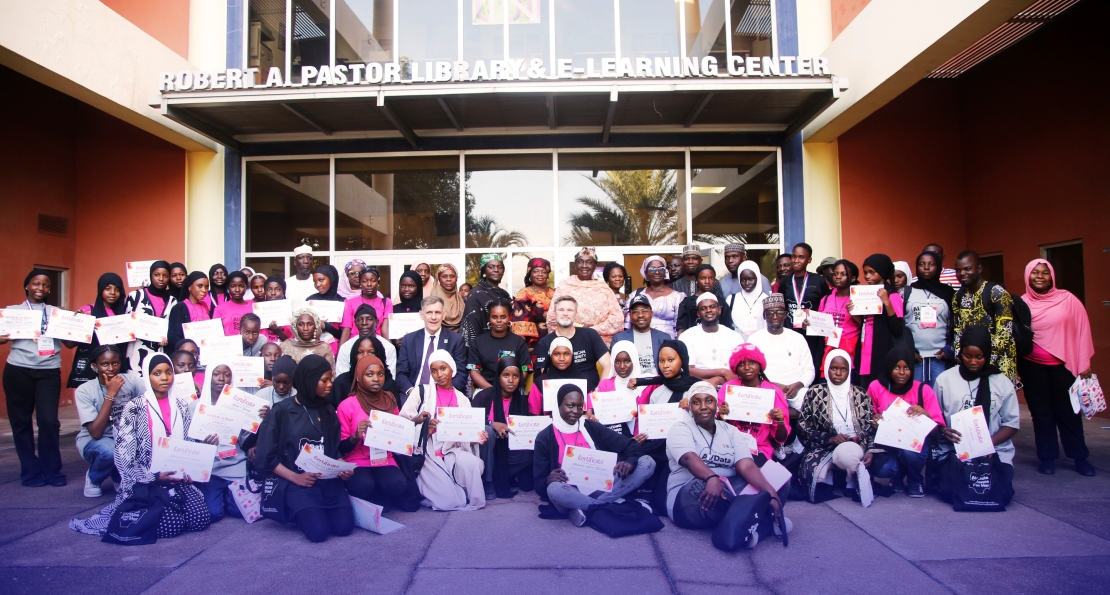
Fifty secondary-school girls in Yola, Adamawa State, have completed a five-day training in artificial intelligence, data science and programming, with several developing project ideas to address challenges in their communities.
The training was organized by the Tech Girls Club under its “AI/Data Science for Her” program and brought together students from public and private secondary schools. It forms part of a wider initiative aimed at increasing girls’ participation in Science, Technology, Engineering and Mathematics (STEM) across Nigeria’s six geopolitical zones.
The Northeast phase of the initiative was launched on August 11, 2026, at the American University of Nigeria (AUN), Yola, which served as a hub for the program. At the opening, facilitators and university leaders encouraged the participants to see technology not only as a career path but also as a means of finding solutions to everyday problems.
Lead Facilitator Dr. Wilson Sakpere said the initiative was created to empower girls and encourage them to explore opportunities in STEM.
He said the broader program targets girls at different stages of their education, including primary and secondary school students and fresh university entrants, to help them develop digital skills, build confidence and overcome the perception that STEM disciplines are too difficult.
AUN President, Prof. DeWayne Frazier, urged the participants to embrace technology and recognize its potential to change how people learn, work and solve problems.
Reflecting on the evolution of technology, Frazier recalled how scientific calculators changed the way students worked with formulas, equations, variables, and programming. He encouraged the girls to look beyond using technology and consider themselves as future creators. “You should see yourselves as future creators of technologies that can shape society,” he told the participants.
Also speaking at the opening, AUN Vice President of Finance, Mrs. Nnenna Mosugu, told the girls, “You’ve been selected to do something extraordinary.”
Mrs. Mosugu noted that women remain underrepresented in fields such as information technology and data science, even as these areas increasingly influence the future.
She said women needed to be involved in developing technologies that could transform sectors such as healthcare, education and agriculture, adding that their participation would help ensure that solutions also address challenges affecting women and their communities.
Over the period of five days, the participants moved from the introductory sessions into practical training in Python programming, Microsoft Excel, data analysis, data presentation and artificial intelligence.
Program Manager of Tech Girls Club, Wonderful Osalor, said the training was intended to take the girls beyond basic digital literacy and give them practical skills they could use to develop solutions to problems around them.
She said some participants arrived with little or no coding experience but left with greater confidence in their ability to work with technology. “These ladies came in, some of them had prior experience, but they had never written a line of code before. But today, every one of them is a lot more confident in their ability to embrace technology,” Osalor said.
That confidence was reflected in the projects developed during the training. The students explored issues including waste management, education, malaria prevention, smart learning, emergency response, business development, smart farming and climate change.
Irene Sunday Gidado, a student of Air Force Comprehensive School, Yola, said the program gave her practical experience in programming and data analysis. Gidado said she learned Python programming and Excel and used the skills in a project exploring how artificial intelligence could improve waste management and disposal in Yola.
Adama Abdullahi Adamu of Ahmadu Ribadu College, Yola, developed a project focused on using artificial intelligence to address challenges affecting the quality of education. She said she also learned how to use Excel, Python programming, and charts to make data presentation clearer and more effective.
Dr. Sakpere, said the practical projects were an important part of the program's purpose. He added that the initiative was designed to address barriers that prevent many girls from accessing quality education and opportunities in technology-related fields.
He explained that bringing together students from public and private schools was a deliberate effort to promote broader access to technology education.
Sakpere said early exposure to STEM, artificial intelligence and data science could help girls build confidence, strengthen their problem-solving abilities and prepare for an increasingly technology-driven economy.
The Yola training is part of the Tech Girls Club’s wider effort to increase girls’ access to technology education and encourage greater participation in STEM.
As the initiative expands across Nigeria’s six geopolitical zones, the organizers hope to equip more girls with the skills and confidence to use technology not only to pursue careers but also to respond to problems in their communities.
Reported by Pwagreno Blessig Morris