

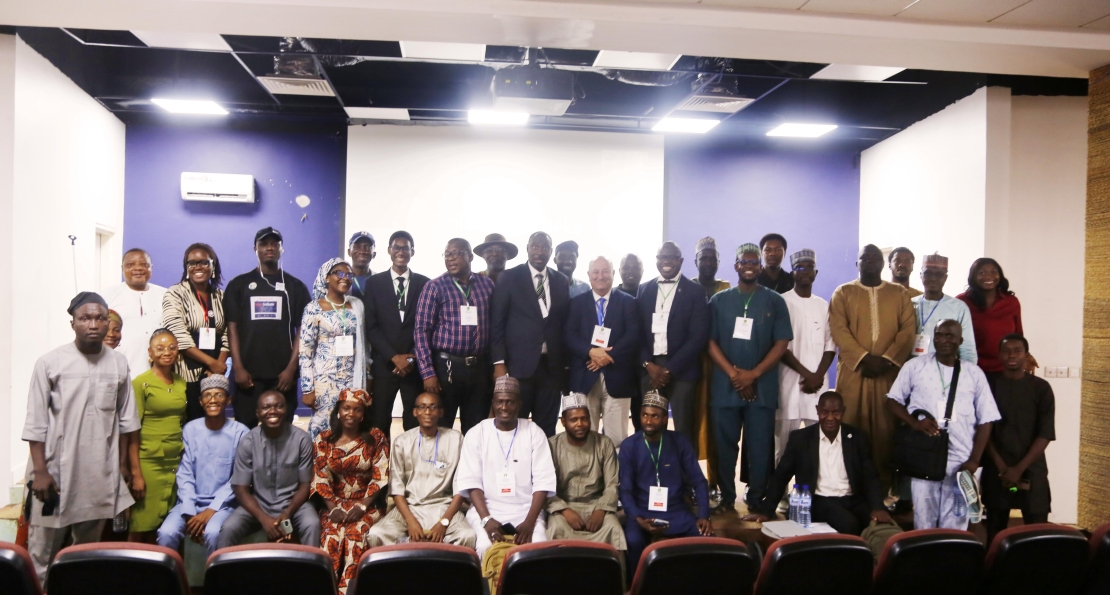
Nigeria must develop its own Artificial Intelligence (AI) solutions, supported by sound mathematical foundations and clear legal frameworks, to address the country's unique challenges, experts said at the 4th AUN International Conference (AUNIC 2026).
Speaking on October 29, 2026, at the American University of Nigeria, experts in mathematics, computing, and law cautioned that relying too heavily on foreign technology could leave Nigeria vulnerable. They called for closer collaboration among universities, industry, and government to strengthen the country's capacity to develop and apply AI solutions that respond to local needs.
In the opening keynote, Prof. Remilekun Odekunle of the Faculty of Physical Sciences, Modibbo Adama University (MAU), Yola, explained the mathematical principles underpinning AI, highlighting the importance of optimization in how the technology works.
“Behind every AI system are algorithms, data, computing, and, fundamentally, optimization,” Odekunle said. “Mathematical optimization is the use of mathematics to help us make the best decisions.”
Although AI has the potential to transform healthcare, education, and public safety, Odekunle cautioned against assuming that the technology is always reliable. He pointed to its high computational costs, energy demands, and mathematical complexity, noting: “AI is not perfect, and that is why systems like ChatGPT and Gemini acknowledge that they can make mistakes.”
He urged researchers to strengthen their understanding of mathematics as a foundation for advancing AI research and addressing the technology's limitations. He also expressed concern about the weak links among universities, government, and industry, which he said contribute to Nigeria's continued dependence on foreign technology providers.
Taking the discussion further, Prof. Etemi J. Garba of MAU's Faculty of Computing stressed that Nigeria must move beyond adopting technologies developed elsewhere and invest in AI solutions shaped by its own realities. “We must develop AI that is local, built on local data, and designed to solve the real problems of our people,” Garba said.
He drew attention to the challenges facing Northeast Nigeria, noting that existing regional technology infrastructure could be used to support efforts to address poverty, improve public health, and expand access to education.
The discussions also turned to the legal questions surrounding the growing use of AI. Senior Advocate of Nigeria (SAN) Musa A. Attah examined the challenges of assigning responsibility when autonomous systems and generative AI produce misleading or fabricated information.
Referring to cases in which AI tools have generated fictitious legal precedents, Attah posed a question with significant implications for the legal profession: Who should be held responsible when AI produces false information—the developer, the deployer, or the user?
“AI has come to stay, but our laws must evolve with it,” Attah stressed. “The challenge is to determine who takes responsibility when AI acts beyond human instruction and to establish clear rules that ensure innovation does not move faster than accountability.”
Together, the presentations highlighted the need to balance technological advancement with local research, practical innovation, and legal safeguards. They also reinforced the importance of stronger partnerships among universities, industry, and government in ensuring that AI development contributes meaningfully to Nigeria's progress.
Reported by Pwagreno Blessing Moris