

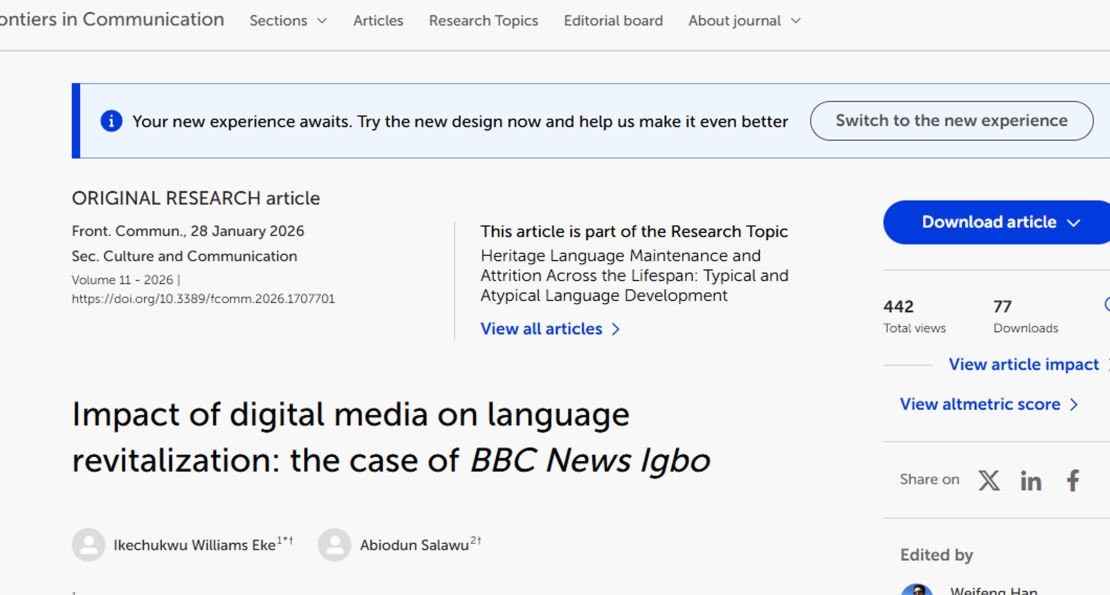
A recent academic study by Ikechukwu Eke, Chair of Communication and Multimedia Design at the American University of Nigeria (AUN), and a research fellow has been published in Frontiers, Volume 11, on January 27, 2026. The study, titled “Impact of Digital Media on Language Revitalization: The Case Study of BBC News Igbo,” highlights the growing role of digital media in addressing the decline of the Igbo language, which UNESCO has classified as critically threatened. Despite being spoken by millions across Nigeria and in the diaspora, the language continues to face challenges, including low prestige, limited presence in mass media, and declining intergenerational transmission.
According to the study, the erosion of the Igbo language is deeply rooted in historical and social factors such as colonial influence, the aftermath of the Nigerian Civil War, migration, dialect disputes, and a long-standing preference for English in education and the media. Together, these factors have diminished the language’s social value, confined its use largely to informal settings, and discouraged younger generations from fully embracing it.
To explore pathways for revitalization, the researchers examined the impact of BBC News Igbo, a digital news platform launched in 2018 by the BBC World Service. The study adopted a mixed-methods approach, combining a web-based survey of BBC News Igbo audiences with semi-structured interviews involving presenters, producers, and Igbo language advocates. Survey data were analyzed using descriptive statistics, while interview responses were subjected to thematic analysis.
Findings from the study indicate that BBC News Igbo has significantly enhanced the prestige and visibility of the Igbo language. Users reported more positive attitudes toward the language, increased confidence in speaking and writing Igbo, and a renewed sense of pride in their linguistic identity. The platform has also expanded the use of Igbo beyond the home into more socially prestigious domains such as education, the workplace, and social media, while connecting Igbo speakers across continents through its digital reach.
The study further revealed that BBC News Igbo has contributed to the digitization and global exposure of the language, making it more appealing to younger audiences and challenging perceptions of Igbo as outdated or unsuitable for modern communication. This growing online presence has encouraged more frequent use of Igbo in everyday interactions and on social media platforms.
Overall, the research demonstrates that digital media—when accessible and culturally relevant—can play a critical role in revitalizing endangered African languages. It concludes that BBC News Igbo has successfully enhanced both the linguistic and social value of the Igbo language, offering evidence that digital platforms can succeed where traditional mass media have fallen short. The authors recommend that language activists, media organizations, and policymakers more actively leverage digital media to protect indigenous languages from decline or extinction.
For more details, click the link below:
https://www.frontiersin.org/journals/communication/articles/10.3389/fcomm.2026.1707701/full
Reported by John Abah